First impressions of Kress and friends (2005 opinions):
On dichotomies:
I have a love/hate relationship with dichotomies (as I’ve made my relationship with them a dichotomy between love and hate…Derrida has ruined my mind). My opinion here extends to categorization and labels in general. Often, to make a point, it’s necessary. I think, though, that we need to be absolutely as clear as possible with our categorization, and not fall into the trap of creating stark dichotomies that cause more problems than they cure.
I have an issue with this: writing vs. image.
For example:
http://www.rafalfedro.com/gfx/gallery/typography/typography03.jpg
This is a visual reproduction of a piece of digital art. But it includes alphabetic text, so is it an image or writing?
What do we call pre-alphabetic texts: writing or images?
http://www.alifetimeofcolor.com/study/images/cave_painting_l.jpg
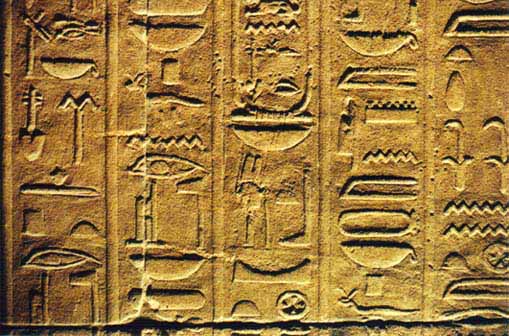
Are hieroglyphs and logographs considered writing or image?
http://k43.pbase.com/g3/93/399693/2/57416695.CRW_3935_01.jpg
http://www.crystalinks.com/hieroglyphs3.jpg
http://www.sino-platonic.org/complete/chinese_character_scripts.gif
What I’m trying to explain is that we need to have a clear theory of writing before attaching labels to semiotic devices. This theory doesn’t have to be accepted as the end-all-be-all in our field, but rather, when using these terms, the person doing so must be able to articulate what they “mean” with regards to the argument at hand. A person’s theory of writing should also be flexible and adapted to the social, historical, technological, etc. events of the time. I am still working on my theory of writing, which is probably why I’m so concerned with this.
Some questions I’ve been asking myself in regards to a theory of writing:
1) What does it mean to write today?
2) What does writing as of us?
3) How is writing influenced by new technologies, and vice versa?
4) Etc…etc…etc…
I have come to terms with one thing in regards to my theory of writing: It is a semiotic mode of representation used to communicate. While that is pretty vague, it does help me to guide my theory.
On the book and the screen:
Another dichotomy, but this one seems more explicitly defined than writing and image. A book is just that: a physical collection of paper bound into a book. A screen is the physical surface that expresses complex computer functions, code, etc. onto a flat screen.
Kress argues that the semiotic changes presently occurring takes place in part because of the “centrality of the medium of the book to the medium of the screen” (6). What I find especially interesting about this ‘phenomenon’ is how the screen influences the physical print text.
Take a look at recent newspaper redesigns:
http://www.poynter.org/column.asp?id=47&aid=151319
I’ve mentioned this before in a previous post, but it is certainly relevant here. These redesigns are much more dependent on non-alphabetic representation: photographs, color, graphic elements, etc. They also refer directly/indirectly to their respective online editions. The Hartford Courant uses the period at the end of its masthead as the ‘dot’ in ‘hartfordcourant.com’.
Zach Dodson’s book, boring boring boring, is especially interesting when considered alongside Kress’ discussion of design. Kress argues, “Design focuses forward; it assumes that resources are never entirely apt but will need to be transformed in relation to all the contingencies of this environment now and the demands made” (p. 20). Dodson’s book is a deconstruction of the traditional book as well as a multimodal text. According to the web site below, the super bundle includes:
You'll get the perfect bound version. With an unerring, unflinching eye for satire, Zach Plague’s brilliant hybrid of image and text skewers the art world and those boring enough to fall into its traps. This one is built for reading.
For hanging on the walls, or lining the rabbit cage, you'll also have the awesome set of nine double-sided large format posters (25 x 38 inches). They were created on the giant ‘signatures’ that all books are printed on, and true works of art in their own right.
Finally, enjoy the soothing sounds of the boring boring Audio Book Mash-up. A shortened, punched up, music/spoken word version of the book, read by a cast of characters with the craziest voices we could find.
http://www.featherproof.com/Mambo/index.php?page=shop.product_details&category_id=1&flypage=shop.flypage&product_id=30&option=com_virtuemart&Itemid=45
The text can be read a number of ways: from left to right in the traditional format; linearly or nonlinearly in the signature/poster format; or hear as an audio book. There is also an online edition, which, strangely enough, mimics the traditional book, complete with turning pages:
http://www.zachplague.com/
I will continue on with my discussion in the version 2.0 post after class on Monday…



Subscribe to:
Post Comments (Atom)
3 comments:
ARGGHH...ok, for some reason, i do not know how to leave a post myself and i have to keep posting my post under the comment section of someone else's post...i dont know what i am doing wrong, and im sorry i keep "replying" to people's posts but i am really not. If someone could help me i would be very, very happy...thanks!
Before reading the responses to Gunther Kress’s work, I read only his work and decided to comment on the Blog in order to save myself some pain (although I have a feeling that when I respond later to the others I may find some of my own points reiterated). I feel that this piece was interesting and I think that multimodality in writing and reading is an important development in the theory of composition and language.
Kress explains about the reader and the reading process and how the reading process binds the reader in most respects due to the fact that they must follow certain rules in order to achieve meaning from the piece; spelling, order, chapters, grammar, these are only a few examples of the things a reader must interact with while reading a written piece. However, the reader is not completely without any freedoms-enter the interpretation process and the reader ability to make meaning from the signs and signifiers inside of the written work, “In reading the traditional page, the reader has to follow the strict order established by the writer while needing to interpret the word-signifiers, turning them into her or his signs”(Kress 9).
Now enters the website and its difference to the former mode(?) of reading…the website allows a “visitor” to access what they want to access and they are not encumbered by orders or text only limitations. The order of the book and its subsequently limitations versus the website of the today and multimodality are examined by Kress and he uses the example of the Institute of Education. He even juxtaposes the terms and changes that occurred within the IoE from 1992 to the Boy Electrician of 1929 and one can see how the terms have changed. He explains that here is knowledge to be gained here and that lies in the order of the different modes, The traditional page had one entry point—though being so naturalized by centuries-long convention, it was not even noticeable
as a feature. It was an entry point given by convention and used by the author…Access to the power of authorship was strictly governed. Here, on the webpage, the presence of thirteen entry points speaks of a very different principle: the author(s) of this page clearly have in mind that visitors will come to this page from quite different cultural and social spaces, in differing ways, and with differing interests, not necessarily known to or knowable by the maker(s) of the page (Kress 9). This is what I like, although I am not avid user of multimodality and I enjoy reading a book much more than reading things online, I do realize that I am living in a changing time for reading, reader, and writing. The availability and freedom of the website and multimodality is not only socially acceptable now, but it may be easer for some students/learners who do not thrive in the black in white of a traditional text may clamp onto something when faced with a website or some other way of creating meaning. I can use an example from my own freshman composition classroom from last semester, a student who complained and bellyached for most of the semester promptly shut his/her mouth when given a multimodality project. The gist of the project was to take a pre-written essay of their own and create a movie-maker using little or no “text” and instead create meaning using pictures and music. Suddenly this student who griped for months was intrigued by a project and presented an awesome piece. Thus, I underestimated him when I graded his papers and he received average or below average grades, perhaps he just needed the right mode to work in? I am not sure if my little example has to do completely with Kress’s work, but then again I just may be doubting myself to do my lack of knowledge in this field—forgive me if I ranted before understanding ☺
Hey Melanie,
I think you need to log in to blogger and then from your dashboard tell it to create a new post.
HTH
Beth
Adding to my post:
I should have mentioned this before when I was extrapolating on the importance of being clear with one's definitions ('writing', 'image', etc.) and having a theory of writing:
Kress discusses these things much further in _Literacy in the new media age_, where he says, "The pressing use of image is forcing a reassessment of what writing is, what it does and does not do, and what it can and cannot do; it forces an insistence on its very materiality - the physicality, the materiality of the stuff that is involved" (p. 10). He continues, "both speech and writing need to be discussed in terms of their materiality as much as in terms of their cultural shaping, in very concrete, quite non-abstract ways" (p. 32).
So, (I'm assuming) that Kress et. al. assumed the reader has read _Literacy in the new media age_ and/or other works by Kress that go into greater detail about these definitions and his theory of writing. Having this type of framework to use is helpful, especially in understanding the readings we will discuss Monday.
Post a Comment